
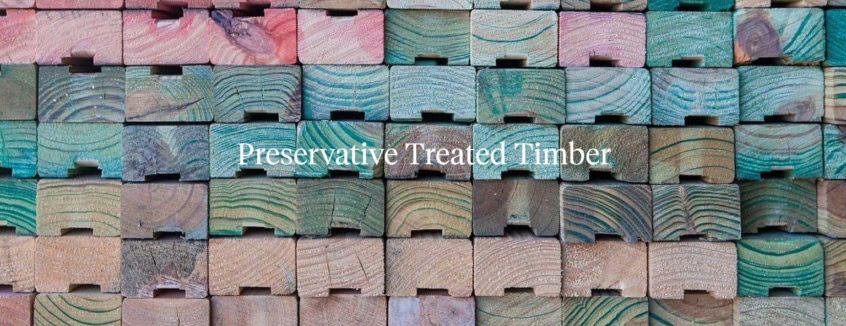

Treatment preservatives will increase the durability of timber by repelling insects such as termites, white ants, and borers. They will also aid in breaking down fungal spores that lead to wood rot. Correct timber treatments will also increase the lifespan of timber used in above- or in-ground applications.
Treatment preservatives are in most cases impregnated into the timber cells via a liquid agent – which can include water, solvents or oils such as linseed. The process varys depending on the timber species, preservatives, carrier agents and treatment hazard level – but can include dipping, spraying or vacuuming the carrier agent into the timber. Timber treatments are primarily focused on protecting the sapwood. The sapwood of all species is considered non-durable (because of its life-supporting starches and sugars), and is comparatively easily penetrated by preservatives. It is not possible to effectively treat the heartwood of many timber species, as heartwood cells contain extractives that prevent the uptake of preservatives.
Types of Preservatives
LOSP (Light Organic Solvent Preservative) is commonly used in high value joinery and products treated in their final form and dimensions. LOSP treatments can only be used in above ground applications, providing up to Hazard Level 3 (H3).
ACQ (Alkaline Copper Quaternary) contains copper and a quaternary ammonium compound. Its colour can range from dark to brownish green, and it is applied using a pressure process as a water-borne preservative. It is free of arsenic and can provide up to Hazard Level 4 (H4). It can be painted or stained when dry.
Copper Azole is a new generation of preservative treatments that are used in water-borne pressure treatment processes. It is a preservative that contains copper, boric acid and tebuconazole and is commonly used with softwood species as an arsenic-free alternative to CCA for treatments up to Hazard Level 4 (H4). It is odourless and can be stained or painted when finished.
CCA (Copper, Chromium and Arsenic) impregnates the timber with water and salts under pressure. Offering a high level of resistance to leaching, CCA can be used on timber exposed to the elements or used in-ground. It is free of odour but has a green appearance which may detract from its appearance. The Australian Pesticides and Veterinary Chemical Authority requires that CCA treated timber may not be used for public projects, children’s playgrounds, garden furniture, picnic tables, external seating, domestic timber decking or handrails.
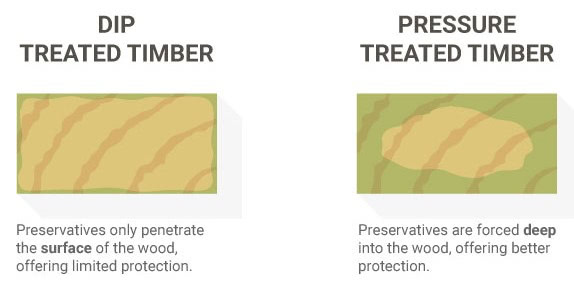
Diagram comparing dip treated timber and pressure treated timber, showing how preservatives penetrate the wood surface versus deep into the timber cells
Treatment Levels and Exposure
| Hazard Level | Location | Exposure | Risk | Typical Applications |
|---|---|---|---|---|
| H1 | Inside, above ground | Completely protected from weather, well ventilated | Termites and borers | Susceptible framing, flooring, furniture, interior joinery |
| H2 | Inside, above ground | Protected from wetting, no leaching | Borers and termites | Framing, flooring, furniture, interior joinery |
| H3 | Outside, above ground | Periodic moderate wetting and leaching | Moderate decay, borers and termites | Weatherboards, fascias, pergolas, framing |
| H4 | Outside, in-ground | Severe wetting and leaching, non-critical applications | Severe decay, borers and termites | Fence posts, retaining walls under 1m, landscaping timbers |
| H5 | Outside, in-ground or fresh water | Extreme wetting and leaching, critical applications | Very severe decay, borers and termites | Piling, house stumps, power poles, building poles, retaining walls over 1m |
| H6 | Marine waters | Prolonged immersion in sea water | Decay and marine wood borers | Boat hulls, marine piles, jetty cross bracing, jetty landing steps |
Knowing that your builder is using the correct timber and treatments for your project (like a brand new deck) is vital for the lifespan of the structure. As outdoor construction specialists, you can be sure that our team only uses the correct timber and treatment of its environment.
Do you have an outdoor project that deserves quality construction?
To see how we can help you put the right foot forward.

Outdoor Entertaining
We all love it! It’s where food is shared, laughter is harvested and lasting memories are created.